Updated Sep 10, 2026 to cover the 4th generation heart rate sensor
Apple Watch’s heart rate monitor measures 10 major metrics of heart health, including HRV, hypertension, resting heart rate, cardio recovery, and more. But do we know how accurate the underlying heart rate sensor is?
Apple’s September 2026 study found that Series 12 had lower overall heart rate error than six competing wearables. Earlier studies measured how often Apple Watch readings fell within 5bpm of a reference. The chart below shows those earlier results:
 Accuracy of Apple Watch heart rate monitor in various settings, for foreground readings. Source: 2024 Apple study.
While sedentary, Apple Watch’s heart rate monitor is accurate to within 5bpm about 98% of the time. During exercise, about 87% of measurements are within 5bpm and 95% are within 10bpm of the ground truth. During background heart rate monitoring, which uses the infrared sensors, about 89% of measurements are within 5bpm and 98% are within 10bpm of the ground truth. (Later in this post, we’ll get into the details of the four generations of optical sensors and three documented algorithms used by the Apple Watch. There’s a lot going on under the hood!)
These numbers are based on Apple’s 2024 study involving tens of thousands of sessions comparing the watch itself to a reference in a custom-built academic lab. They predate the Series 12 sensor.
Apple Watch Series 12 introduces a more accurate 4th generation heart rate sensor
The Apple Watch Series 12, announced September 2026, introduced a 4th generation heart rate sensor with continuous measurements.
Apple Watch Series 12 measured heart rate more accurately overall than all six competing wearables in Apple’s September 2026 accuracy study. Series 12 and Ultra 4 introduce the Health Sensing System, with updated optical and electrical heart sensors and signal-processing algorithms. This study tested Series 12’s optical heart rate measurements.
The study enrolled 1,460 adults at five sites in the U.S. and Malaysia; 1,254 contributed usable paired data. Participants wore Apple Watch alongside a competing wearable, with a Polar H10 ECG chest strap as the reference. Wrist assignment was randomized. Competitors included Garmin Forerunner 970, Google Pixel Watch 4, Huawei Watch 5, Samsung Galaxy Watch 8, WHOOP 5, and Oura Ring 5.
Testing covered running, cycling, HIIT, strength training, rest, desk work, meal preparation, and walking. Oura wasn’t tested during strength training, following its manufacturer’s advice. Researchers measured mean absolute error (MAE), the average size of errors, and root mean square error (RMSE), which gives more weight to large errors. They also checked each device’s session-average heart rate.
| Comparison | Series 12 result |
|---|---|
| Overall workout heart rate | Significantly lower MAE and RMSE than all six competitors |
| Overall everyday heart rate | Significantly lower MAE and RMSE than all six competitors |
| Session-average heart rate | Significantly more accurate in 11 of 12 overall comparisons; the workout comparison with Huawei was inconclusive |
| Individual activities and error metrics | Significantly more accurate in 139 of 159 comparisons; 18 were inconclusive and 2 favored Pixel Watch 4 |
Source: Apple’s 2026 study, Figures 1–3, using 99% confidence intervals. The 159 comparisons include multiple error metrics for the same activities and participants.
Apple Watch’s mean absolute error was approximately 1.2bpm lower during workouts and 0.7bpm lower during everyday activities than Pixel Watch 4, which had the smallest overall MAE gap with Apple among the six competitors. These differences are estimated from Figure 1; the paper doesn’t tabulate exact values.
Pixel Watch 4’s two wins were at rest, by less than 0.5bpm on MAE and RMSE. The cycling comparison with Pixel was inconclusive on both metrics.
The study reports differences in error between devices, so it doesn’t tell us what percentage of Series 12 readings are within 5bpm. It also didn’t compare Series 12 with older Apple Watches or separate the contributions of hardware and software. We can’t use these results to quantify the accuracy improvement over Series 11.
This was an Apple-run study, with 59% of analyzed participants enrolled at third-party research sites. Sessions were short and supervised, with staff helping fit the devices. People taking beta blockers, those with contraindications to intense exercise, and those with tattoos or large moles at device sites were excluded. The results don’t directly validate sleep tracking, HRV, readiness scores, or other metrics derived from heart rate.
Accuracy of Apple Watch heart rate monitor from academic studies
You might reasonably ask: have third party researchers, unaffiliated with Apple, validated the accuracy of the Apple Watch’s heart rate monitor? Several studies have been published.
 Accuracy of Apple Watch heart rate monitor vs Garmin, Fitbit, and Polar. Source: European Journal of Sports Science, 2023.
The Apple Watch’s heart rate monitor was accurate to within 2.3 bpm in a 2023 study of 60 healthy participants. Among patients with cardiovascular disease, a 2019 study found an average error of 6-7 bpm. Earlier studies on the Apple Watch Series 4, which used the second generation of sensors, found higher error. A 2019 study found a correlation of 70%.
2026 meta-analysis: 82 studies, 430,000 participants
A January 2026 meta-analysis of 82 studies found Apple Watch heart rate was accurate to within -3.68 to 2.59 bpm when using recent models. The Apple Watch Series 6 introduced both a third generation heart rate sensor and a new neural network algorithm that increased accuracy.
How Apple Watch’s heart rate sensor works
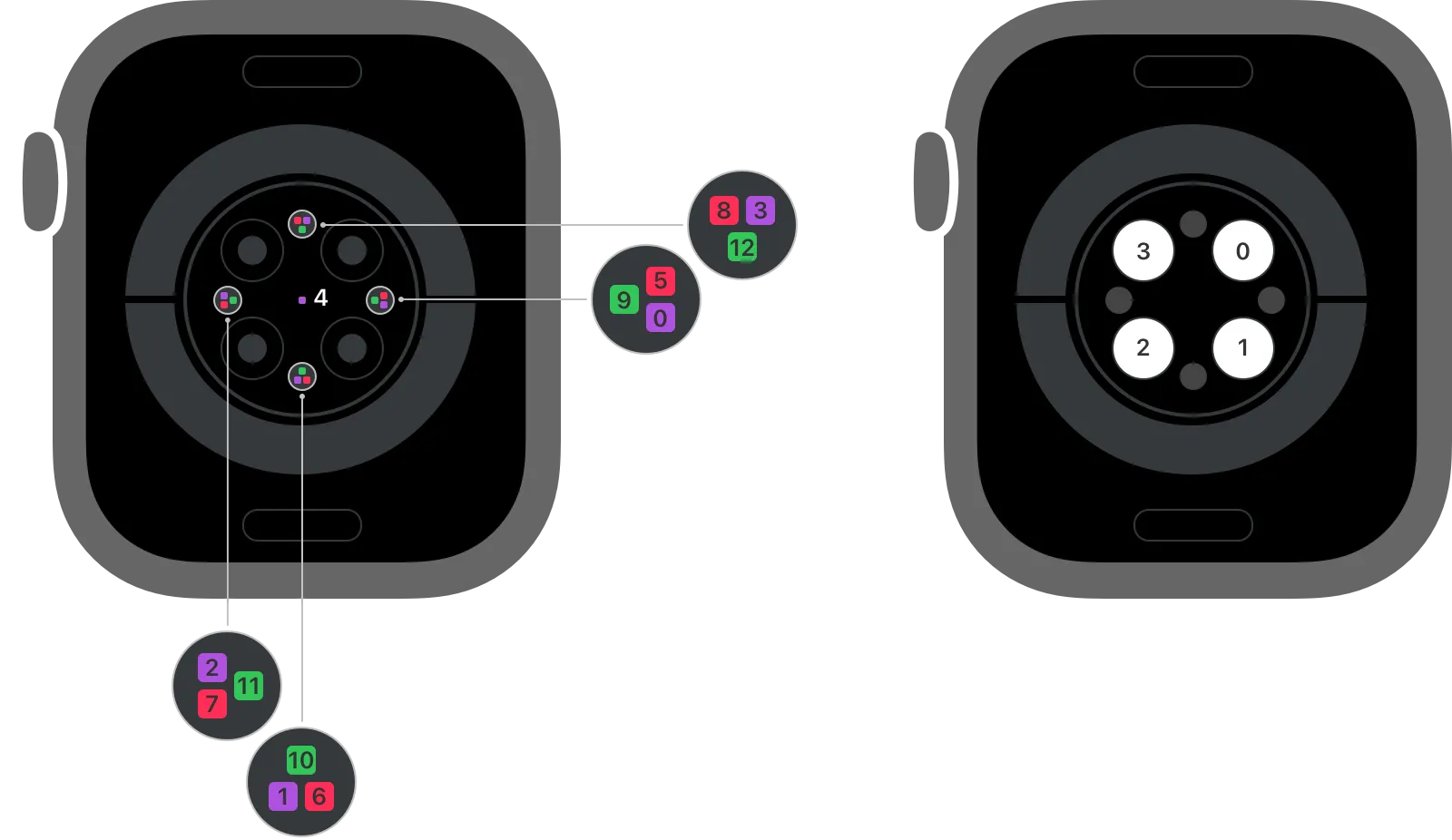
Apple Watch’s optical heart rate sensor uses LEDs to shine light through your skin and an array of photodiodes to measure the light reflected back. There are three wavelengths of light used: green (525 nm), infrared (850-940 nm), and red (660 nm). The green and infrared light are used to measure your pulse, and the red light is used to measure your blood oxygen saturation.
Four generations of Apple Watch’s heart rate sensor
Since the Apple Watch launched in 2015, there have been four versions of the heart rate sensor. The first generation optical heart rate sensor was used from 2015-2017. The second generation was introduced in the Apple Watch Series 4 (2018) and is currently used in the Apple Watch SE2. The third generation was introduced in the Series 6 (2020), and included an oxygen sensor. The 3rd generation sensor is currently used in Apple Watch Series 10, 11, and Apple Watch Ultra 2 and 3. Apple announced the fourth generation on September 9, 2026 with Series 12 and Ultra 4, enabling background heart rate readings every 5 seconds and HRV every 5 minutes. More frequent readings do not, by themselves, establish better accuracy per reading.
| Generation | Year Introduced | Apple Watch Models | Key Features |
|---|---|---|---|
| First gen optical heart rate sensor | 2015 | Apple Watch Series 1-3, SE | Basic heart rate monitoring |
| Second gen optical heart rate sensor | 2018 | Apple Watch Series 4, 5, SE2 | Improved accuracy, lower power consumption |
| ECG Sensor | 2018 | Apple Watch Series 4 and later | FDA-cleared Class II medical device for electrocardiogram readings |
| Third gen optical heart rate sensor | 2020 | Apple Watch Series 6-11, Ultra 1/2/3 | Blood oxygen monitoring capability |
| Fourth gen | 2026 | Apple Watch Series 12, Ultra 4 | Background heart rate every 5 seconds; HRV every 5 minutes |
Apple Watch uses three heart rate monitoring algorithms
Apple’s documentation predating the fourth-generation sensor describes three different algorithms to measure your heart rate: foreground, background, and tachygram. The accuracy figures below come from that earlier testing.
- Foreground: uses green lights to measure heart rate. The foreground algorithm is accurate to within 5bpm 98% of the time.
- Background: uses infrared light to measure heart rate. The background algorithm is accurate to within 5bpm 89% of the time, and 10bpm 98% of the time. Infrared lights are chosen because they use less power.
- Tachygram: uses green PPG to measure heart rate. 99.6% of tachygrams are within 5bpm of the ground truth when you’re in normal heart rhythm (sinus rhythm). In abnormal rhythms like atrial fibrillation, tachygrams are within 5bpm 95% of the time.
Tachograms are used to measure HRV (heart rate variability). The previously documented cadence was every 4 hours by default, every 2 hours with irregular rhythm notifications, or every 15 minutes with AFib History. The fourth-generation sensor brings HRV measurements every 5 minutes. This does not establish a matching change to the rhythm-notification or AFib History algorithms.
Optical heart rate sensor vs ECG sensor
The Apple Watch has two heart rate sensors: the optical heart rate sensor and the ECG sensor. The optical sensor uses light to measure your heart rate, whereas the ECG measures the electrical signals generated by your heart. A doctor can use the ECG to diagnose heart rhythm disorders, like atrial fibrillation, atrial flutter, supraventricular tachycardia, and more.
Health metrics derived from heart rate
We wrote a separate post on the 10 metrics derived from heart rate monitoring, as well as detailed posts on Apple Watch resting heart rate, Apple Watch cardio recovery, Apple Watch HRV, Apple Watch cardio fitness (vo2max).
Bottom line on Apple Watch heart rate monitor accuracy
Studies support the accuracy of earlier Apple Watch heart rate sensors, and Apple’s 2026 study adds evidence that Series 12 has lower overall heart rate error than the six competing wearables tested. How much accuracy improved over older Apple Watches remains untested in that study, as does the accuracy of metrics derived from heart rate.
Get your free 30-day heart health guide
Evidence-based steps to optimize your heart health.