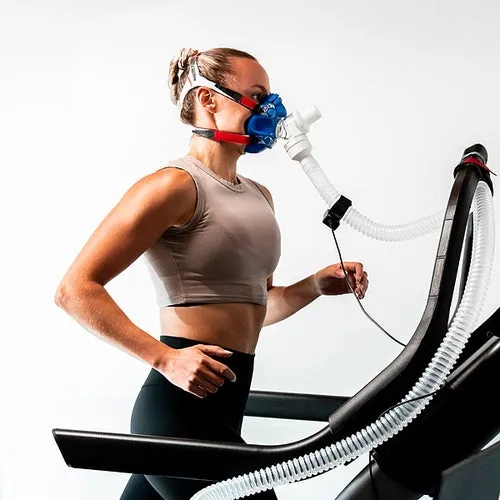
The single most popular VO2Max advice on the internet (do more zone 2) is incomplete, and probably the reason a lot of people have plateaued.
The medical literature is consistent on this point. Across Bacon 2013, Milanović 2015, and Weston 2014, high-intensity interval training produces roughly twice the VO2Max gains of moderate continuous training (around 19% vs 10% in cardiometabolic patients, with similar ratios in healthy adults). Most people doing “cardio” are training in a zone that’s too hard to be true zone 2 and too easy to grow VO2Max. They’re stuck in the middle.
VO2Max is also one of the more trainable systems in the body. Sedentary middle-aged adults in Levine’s 2018 sedentary-aging-reversal trial gained 18% in two years, with measurable reversal of cardiac stiffness. Studies show you can boost VO2Max 10-15% in 8 weeks. The ceiling is high if you train the right way.
This post covers how fast you can expect VO2Max to rise, the protocols with the strongest evidence (Norwegian 4x4, Tabata, polarized 80/20, the Norwegian double-threshold method), how zone 2 fits in, what older adults can expect, the most common mistakes, and a concrete weekly plan you can run on Monday.
If you want the mechanism for why VO2Max is really a measurement of your heart, see our companion piece on the Fick equation and your heart.
How fast can you improve VO2Max?
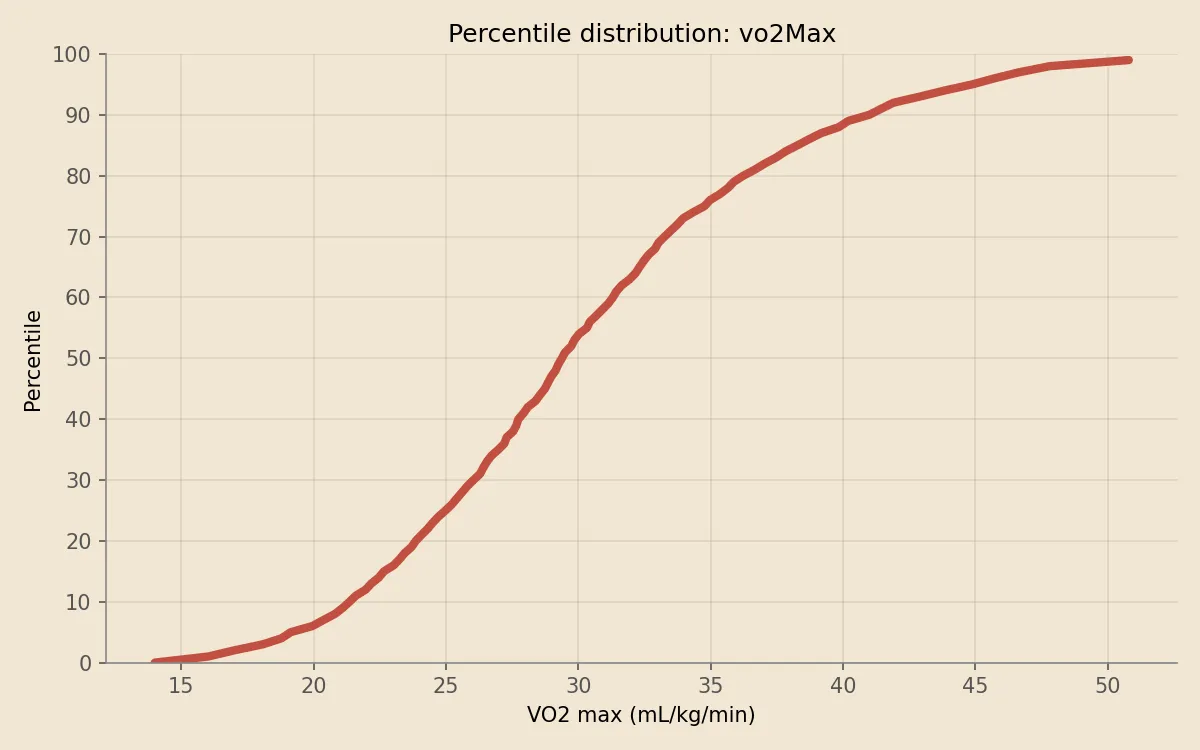
VO2Max improves faster than most other longevity-relevant metrics. Three benchmarks:
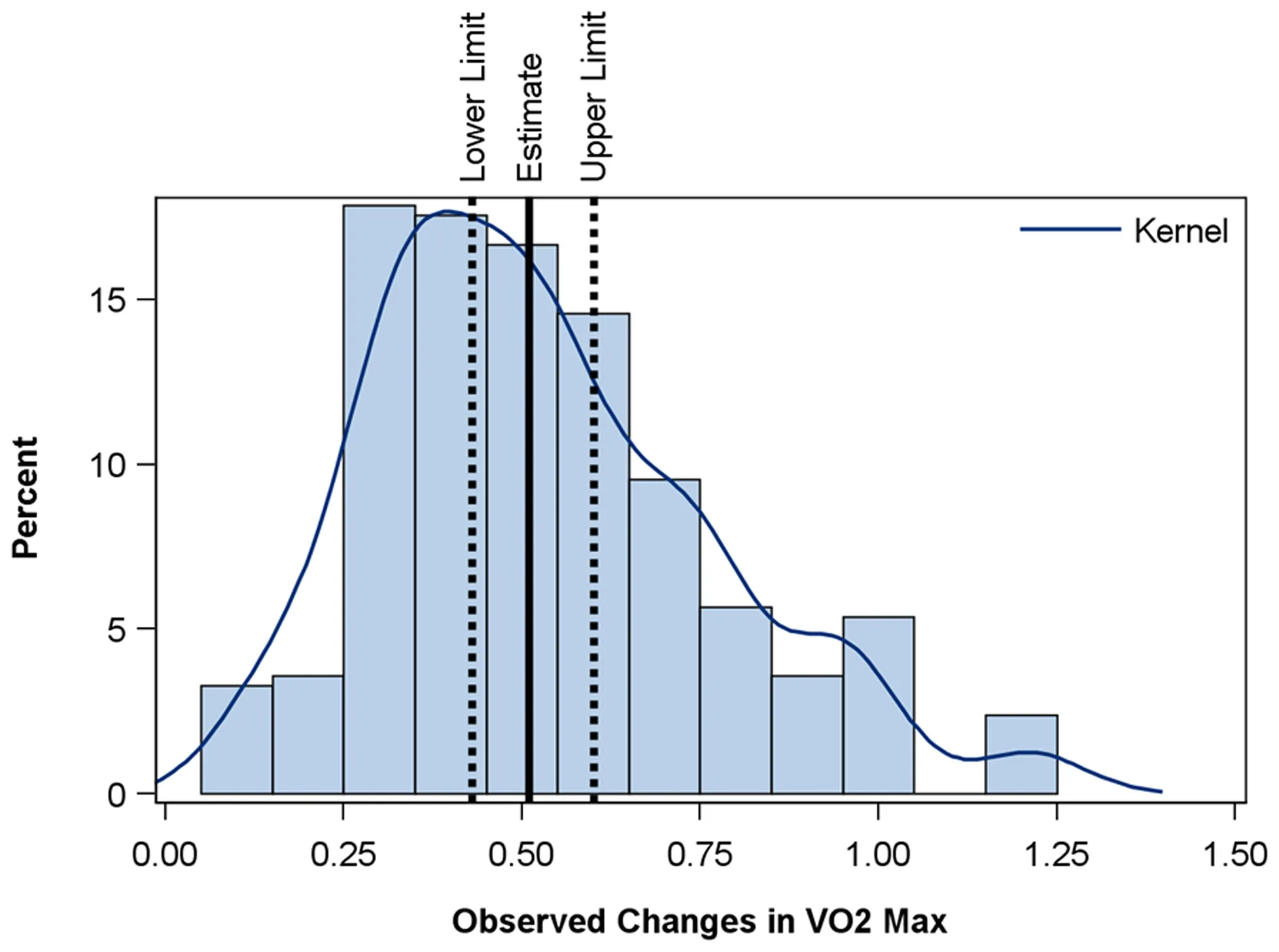
- Untrained subjects improve VO2Max by 10-20% in 8-12 weeks. A meta-analysis of 37 studies found an average VO2Max increase of 0.51 L/min, with longer 3 to 5 minute intervals producing the biggest jumps (0.8 to 0.9 L/min). Helgerud 2007 reported a 13% gain in 8 weeks of 4x4 training.
- Sedentary middle-aged adults improve 18% in 2 years. Levine 2018 ran 61 sedentary 45 to 64 year olds through a structured program. The exercise group went from 29 to 34 ml/kg/min (an 18% gain), and their hearts became measurably less stiff. Controls actually lost a bit of fitness.
- Decades, lifelong athletes. Masters athletes can stay elite into their 70s and 80s, but the largest stroke-volume adaptations from Levine 1991 take years to fully develop.
The first 8 to 12 weeks are the steepest part of the curve. Then progress slows and gains depend more on volume, intensity precision, and recovery.
Why some people gain more VO2Max than others
Trainability has a strong genetic component. The HERITAGE Family Study trained 481 sedentary adults from 98 families for 20 weeks on identical bikes at identical intensities. While the average VO2Max gain was 400 ml/min, individual responses ranged from zero to over 1.0 L/min, and roughly 47% of the response is heritable. Practically speaking, if you do everything right and barely move in 12 weeks, you may need more volume, higher intensity, or both. Apparent non-responders to a low-volume protocol often respond to a higher-volume one. The most common reason for non-response is an insufficient training dose.
What kind of exercise improves VO2Max the most?
Three meta-analyses converge on the three exercises to improve VO2Max: high-intensity interval training (HIIT) beats moderate continuous training, and longer intervals (3 to 5 minutes) beat shorter ones for VO2Max specifically.
- Milanović 2015: HIIT produced 4.9 ml/kg/min gains vs 3.5 ml/kg/min for steady-state, in healthy young to middle-aged adults.
- Weston 2014: in patients with cardiometabolic disease, HIIT produced ~19% gains vs ~10% for moderate continuous training.
- Bacon 2013: 3 to 5 minute intervals produced larger VO2Max changes (0.8 to 0.9 L/min) than shorter ones, with most subjects responding.
The mechanism (covered in our Fick equation post) is that long, hard intervals push the heart to operate at maximum stroke volume and maximum cardiac output for sustained periods. That’s the stimulus for the cardiac remodeling (greater end-diastolic volume, greater ventricular compliance) that raises VO2Max.
The Norwegian 4x4 protocol
The single most-studied VO2Max workout is the Norwegian 4x4, developed by Jan Helgerud and Ulrik Wisløff at NTNU in Trondheim.
The protocol:
- 10 minute easy warmup
- 4 minutes at ~90 to 95% of max heart rate (RPE 17 to 18, “very hard” but sustainable)
- 3 minutes active recovery at ~70% max HR
- Repeat for 4 total work intervals
- 5 to 10 minute cooldown
Total time: about 40 minutes. The hard work adds up to 16 minutes.
Evidence: Helgerud 2007 compared 4x4 to lactate-threshold continuous running and to long slow distance over 8 weeks. The 4x4 group gained ~13% VO2Max, the threshold and continuous groups gained ~3 to 4%. Wisløff 2007 showed even larger gains in heart failure patients (about 46% in peak oxygen uptake) compared to moderate continuous training.
What about Tabata intervals?
The other famous interval workout is Izumi Tabata’s 1996 protocol: 8 rounds of 20 seconds at 170% of VO2Max with 10 second rests, for 4 minutes of total work. The original study found the Tabata group gained ~7 ml/kg/min over 6 weeks, slightly more than a 60-minute steady-state group, plus a 28% gain in anaerobic capacity that the steady-state group didn’t get.
The catch is intensity. The original Tabata required a sport-specific bike at 170% of VO2Max, which is genuinely brutal. If you can talk between rounds, it’s not Tabata. For VO2Max specifically, longer 3 to 5 minute intervals like the 4x4 produce larger gains, per the Bacon meta-analysis.
Polarized training: 80% easy, 20% hard
A separate question is how to structure intensity across the whole week, not just within a single workout. The dominant model in endurance research is polarized training, popularized by Stephen Seiler: about 80% of training time at low intensity (zone 2 or below), about 20% at high intensity (zone 4 to 5), and very little time in the moderate middle. Seiler observed this pattern in elite endurance athletes across rowing, cross-country skiing, cycling, and running, regardless of country or coaching philosophy.
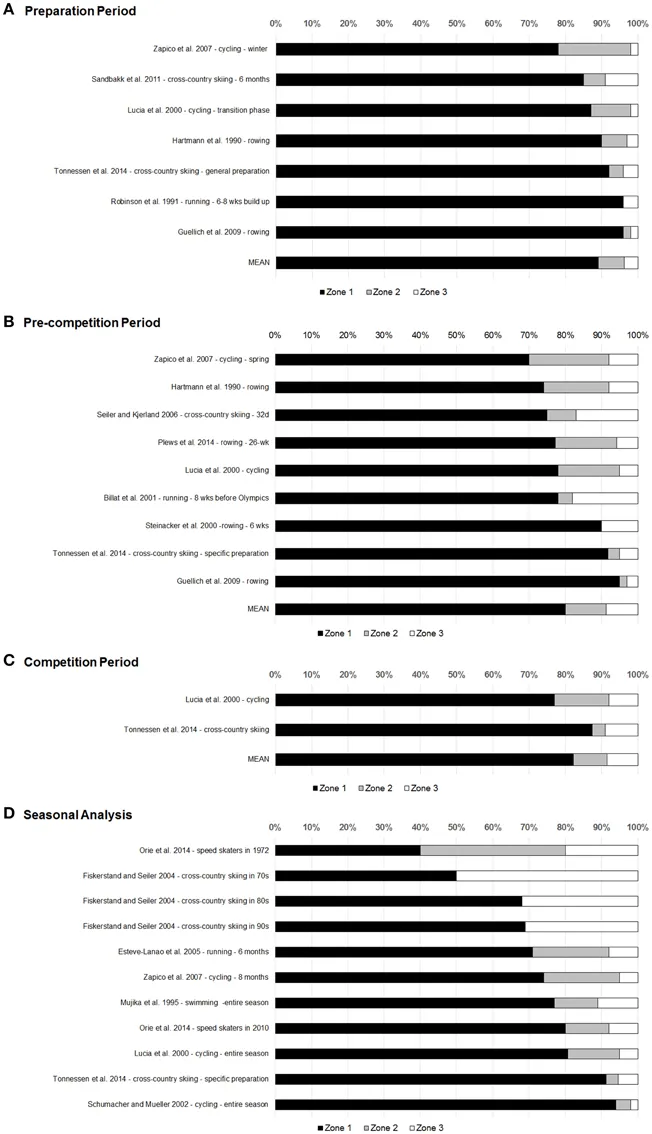
Why it works. Easy work builds aerobic base (mitochondrial density, capillary density, fat oxidation, lactate clearance) without much fatigue cost. Hard work drives the cardiac adaptations that raise VO2Max. The “tempo” zone in between produces real fatigue with mediocre stimulus, crowding out both base and quality intensity.
The most common mistake in popular fitness culture is too much time in that middle zone. Threshold runs feel productive (they’re hard), but fatigue you enough that easy days aren’t easy and hard days aren’t hard. Polarized training fixes this by forcing easy days to be honestly easy.
How much volume do you need to improve VO2Max?
Levine’s 2-year trial used a specific dose that produced the 18% VO2Max gain: 4 to 5 sessions per week, 1 HIIT, 1 longer hard session (about an hour at moderate-vigorous), 2 to 3 zone 2 sessions, and 1 strength session. That’s about 5 to 6 hours of cardio per week. Most participants stuck with it.
For someone starting from sedentary, meta-analyses show meaningful gains with as little as 3 sessions of 30 to 35 minutes per week for 16 to 20 weeks (around 3.8 ml/kg/min, or 16% in older adults). More volume produces more gain up to a point, with diminishing returns past about 5 to 7 hours per week for non-athletes.
What about zone 2 training?
Zone 2 (the highest intensity at which blood lactate stays below ~2 mmol/L, roughly RPE 6 to 7, conversational pace) is the workhorse of the polarized model. It’s the bulk of the 80%. What zone 2 does well:
- Builds mitochondrial density and capillary density in skeletal muscle (the peripheral side of VO2Max).
- Improves fat oxidation and metabolic flexibility.
- Adds training volume without recovery cost, which is what lets you also do hard intervals.
What zone 2 doesn’t do as well as HIIT:
- Stretch and remodel the left ventricle, which is the main driver of VO2Max gains in trained adults. If you only have 2 to 3 hours a week and want to maximize VO2Max specifically, prioritize one HIIT session and fill the rest with zone 2. If you have 5+ hours a week, the polarized 80/20 distribution is the evidence-based default.
Can you raise VO2Max in your 50s and 60s?
Yes, and the data is striking. Levine’s 2018 study targeted exactly this age window (45 to 64) and produced an 18% VO2Max gain over 2 years in previously sedentary adults. More importantly, the exercise group’s left ventricular stiffness decreased: their hearts became more compliant, more like the hearts of healthy younger people. The control group’s hearts continued to stiffen.
The implication is that cardiac changes typically attributed to aging (a stiff, less-compliant heart that fills less per beat) are partly preventable and partly reversible, with enough intensity for long enough. Levine has called late middle age “the sweet spot”: old enough that the changes are visible, young enough that they’re still reversible. A separate 2005 meta-analysis of 41 trials in 2,102 older adults (mean age 60+) found a 16.3% improvement in VO2Max with structured endurance training, with bigger gains in programs lasting more than 20 weeks.
Common mistakes that flatline VO2Max
Most VO2Max plateaus are due to one of these problems:
- Training too moderate. If you finish a “hard” workout able to chat normally, your heart never approached the zone where stroke volume gets remodeled.
- Skipping the easy work. Five tempo sessions a week leaves you fatigued and unable to nail the one true HIIT session that would have moved the needle.
- No progression. The same 4x4 at the same effort for 12 months won’t keep producing gains. Increase pace, add a 5th interval, or shorten recoveries every few weeks.
- Too little volume. Three 20-minute HIIT sessions is enough to start, not enough to plateau-bust. Sustained weekly hours matter, not just intensity.
- Ignoring sleep. Sleep loss drops time-to-exhaustion at 80% VO2Max by about 11%. Adaptation happens in recovery, not the workout. Aim for 7 to 9 hours, especially after hard sessions.
- Detraining accidentally. Two weeks off causes ~4 to 5% VO2Max loss; 5 weeks, ~10%; 8 weeks, ~13 to 20%. If you have to cut volume, keep one HIIT session per week. That alone preserves most of the gains.
- Neglecting strength. Concurrent strength training does not blunt VO2Max gains in meta-analyses, and stronger legs raise the ceiling on what intensities you can hit during intervals.
A starter weekly plan
A concrete plan you can copy. Adjust hard-session pace based on your current fitness, but the structure is what most people in the literature converge on.
- Monday: Zone 2, 45 to 60 min (bike, easy run, brisk walk on incline, rowing). Conversational pace.
- Tuesday: Norwegian 4x4. 10 min warmup, 4x (4 min hard / 3 min easy), 5 to 10 min cooldown.
- Wednesday: Strength training, 45 to 60 min. Compound lifts (squat, deadlift, press, row). Two to three sets near failure.
- Thursday: Zone 2, 45 to 60 min, or rest if you need it.
- Friday: Tempo or threshold, 30 to 40 min total work near lactate threshold (RPE 13 to 15). This is the only “moderate” session and it’s optional; some weeks skip it for more zone 2.
- Saturday: Long zone 2, 60 to 90 min. The longest session of the week.
- Sunday: Rest or active recovery (walk, yoga, easy spin).
In total, this is about 5 hours of cardio plus 1 strength session. If 5 hours is too much, drop the Thursday or Friday and keep the Tuesday HIIT session non-negotiable.
How to know it’s working
Retest every 8 to 12 weeks. Options, in order of accuracy:
- Lab-based CPET. Gold standard, costs $150 to $400 in most cities.
- A wearable VO2Max estimate. Apple Watch’s cardio fitness algorithm is accurate to within ~1.2 ml/kg/min in Apple’s validation, with a larger error in independent studies; either way, it’s better at trends than absolute values.
- Submaximal field tests like the Cooper 12-minute run or 1.5-mile time. Cheap, surprisingly informative if you do them consistently.
Don’t read too much into a single 1 ml/kg/min change. Day-to-day measurement noise is real. Look at the trend over 2 to 3 months.
 VO2Max in Empirical, using example data.
If you want to track your VO2Max trend alongside resting heart rate, heart rate recovery, and other heart metrics, Empirical Health for Apple Watch charts cardio fitness over time, and our VO2Max guide walks through how to interpret the numbers.
Get your free 30-day heart health guide
Evidence-based steps to optimize your heart health.