Normal range: 32 – 36 g/dL (higher is better)
MCHC measures how concentrated hemoglobin is within your red blood cells. Unlike MCH (total hemoglobin per cell), MCHC tells you how densely packed the hemoglobin is relative to cell size. Low MCHC means pale, hemoglobin-poor cells, which is characteristic of iron deficiency. High MCHC is rare and usually indicates a structural red cell problem.
A normal MCHC is 32 – 36 g/dL. Higher is better.
Low MCHC is characteristic of iron deficiency anemia and thalassemia. The red cells appear pale under a microscope because they contain less hemoglobin. Treating the underlying iron deficiency normalizes MCHC.
High MCHC is uncommon and may indicate hereditary spherocytosis (a genetic condition where red cells are small and spherical, concentrating hemoglobin into a smaller volume), severe dehydration, or autoimmune hemolytic anemia. Cold agglutinin disease can also cause a falsely elevated MCHC.
The same dietary and supplementation strategies that address iron deficiency (iron-rich foods, iron supplements with vitamin C) apply to low MCHC. High MCHC typically requires medical evaluation rather than lifestyle changes.
MCHC measures the average concentration of hemoglobin in a given volume of red blood cells. Helps diagnose certain types of anemia.
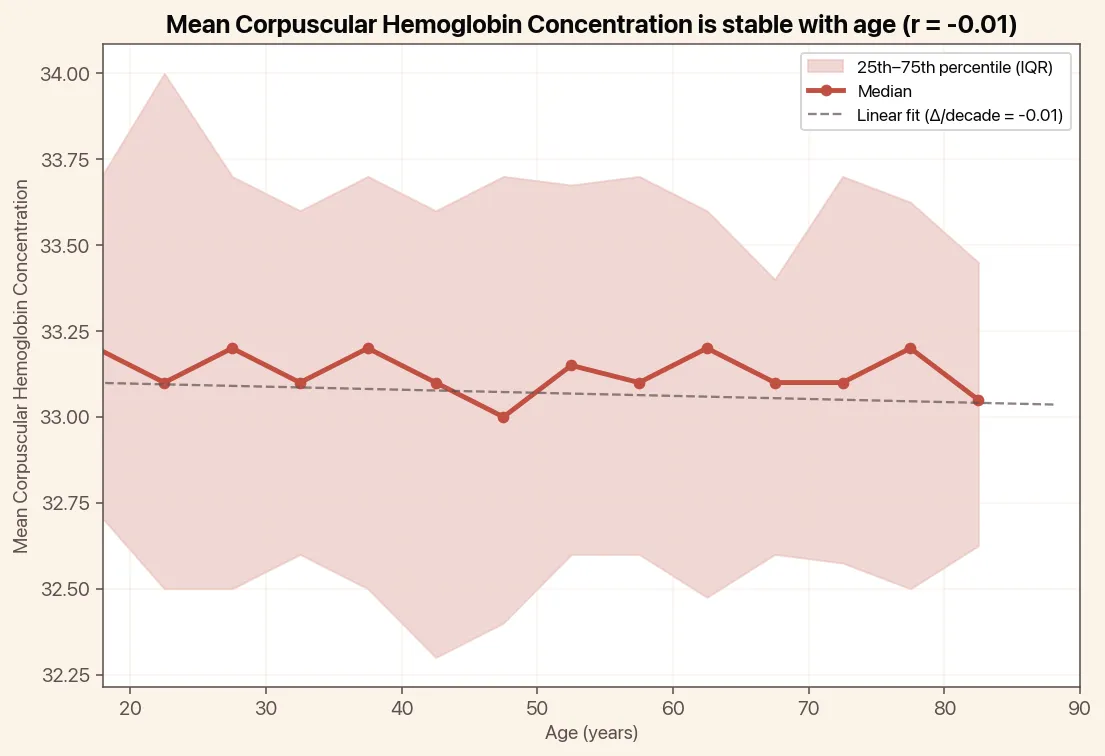
Mean Corpuscular Hemoglobin Concentration stays relatively flat across adult ages (correlation with age, r = -0.01). Most of the spread in the chart below comes from differences between people rather than from age.

MCHC is most highly correlated with Hemoglobin and Creatinine. Here are the top biomarkers correlated with MCHC, based on 500,000 tests done by Empirical Health.
The percentage shows how strongly two biomarkers move together. A higher number means the relationship is stronger. Green = rises and falls together. Orange = one rises as the other falls.
MCHC comes in a complete blood count (CBC) (about $29–$45), or $190 with Hemoglobin, Hematocrit, and 100+ other biomarkers at Empirical Health.
You can measure your MCHC for at 2,200+ testing locations across the US. Click below and enter your zip code to browse locations near you.
Test your Mean Corpuscular Hemoglobin Concentration and 100+ other biomarkers in a single blood draw.