Use your HSA/FSA funds to join Empirical

Urine pH

Normal range: 4.5 – 8 pH (higher is better)

Urine pH reflects how acidic or alkaline your urine is. Most people produce slightly acidic urine around pH 6. Your diet is the biggest influence: high-protein and meat-heavy diets make urine more acidic, while vegetarian and fruit-heavy diets make it more alkaline. Urine pH matters most for kidney stone risk, since different types of stones form at different pH levels.

Test your Urine pH

What can cause low Urine pH?

A normal Urine pH is 4.5 – 8 pH. Higher is better.

Acidic urine (low pH) results from high-protein diets, dehydration, diabetic ketoacidosis, and gout. Cranberry juice also acidifies urine. Alkaline urine (high pH) is commonly caused by urinary tract infections with urease-producing bacteria, vegetarian diets, and certain medications (acetazolamide, sodium bicarbonate, potassium citrate).

Kidney stones form more readily at pH extremes: uric acid stones in acidic urine, calcium phosphate and struvite stones in alkaline urine. If you are prone to kidney stones, your doctor may recommend dietary changes or medications to shift your urine pH toward a safer range.

Diet is the most effective lifestyle lever. Eating more fruits and vegetables shifts urine toward alkaline. Eating more protein and grains shifts it toward acidic. Staying well-hydrated dilutes the urine and reduces stone risk regardless of pH. Medications like potassium citrate can raise urine pH, while vitamin C supplements and ammonium chloride can lower it.

Urine pH reflects how acidic or alkaline your urine is. Most people produce slightly acidic urine around pH 6. Your diet is the biggest influence: high-protein diets make urine more acidic, while vegetarian and fruit-heavy diets make it more alkaline. Urine pH matters most for kidney stone risk, since different stone types form at different pH levels.

How does Urine pH change with age?

Urine pH tends to fall with age (correlation with age, r = -0.06). The chart below shows the median by 5-year age bin and a linear trend line.
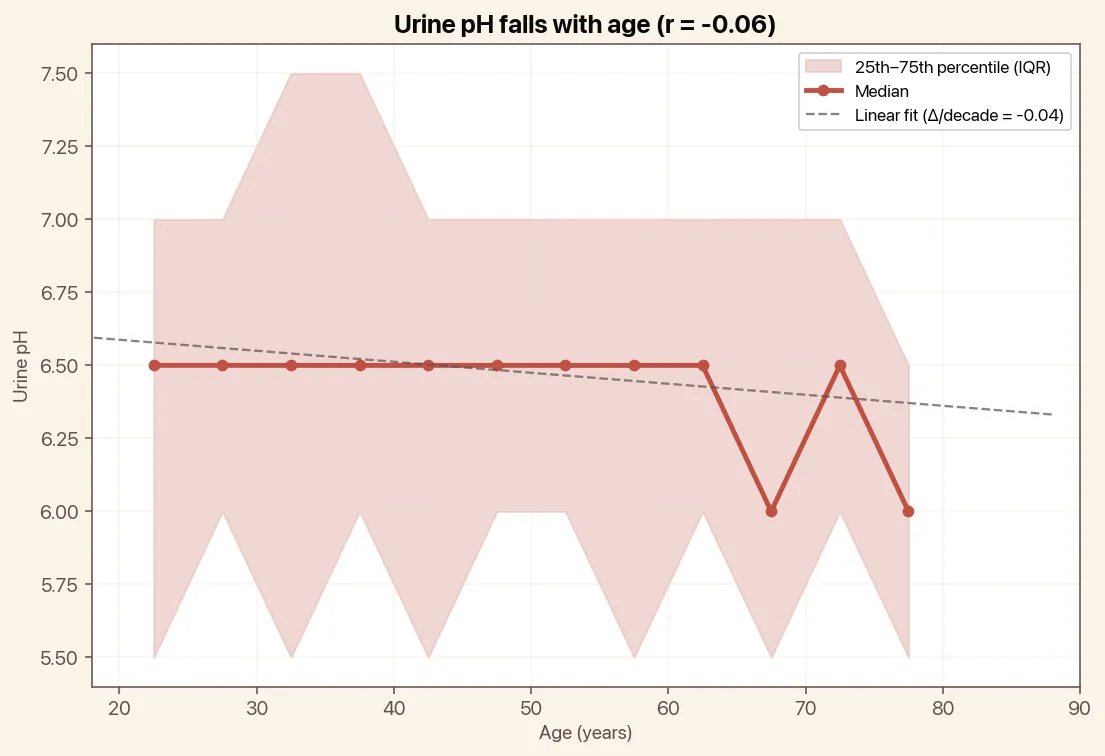

Urine pH falls with age, chart with median and linear trend

Biomarkers related to Urine pH

Urine pH is most highly correlated with BUN and Carbon Dioxide. Here are the top biomarkers correlated with Urine pH, based on 500,000 tests done by Empirical Health.

The percentage shows how strongly two biomarkers move together. A higher number means the relationship is stronger. Green = rises and falls together. Orange = one rises as the other falls.

Frequently asked questions about Urine pH

Urine pH test cost

You'd typically get Urine pH through a routine urinalysis (about $40–$50 at Quest or LabCorp). The same marker is part of a 100+ biomarker panel from Empirical Health for $190.

Get tested for $190

Where to test Urine pH

You can measure your Urine pH for at 2,200+ testing locations across the US. Click below and enter your zip code to browse locations near you.

Find a testing location near you

Know your Urine pH. Know your health.

Test your Urine pH and 100+ other biomarkers in a single blood draw.

Image of a man on cellphone
Start testing